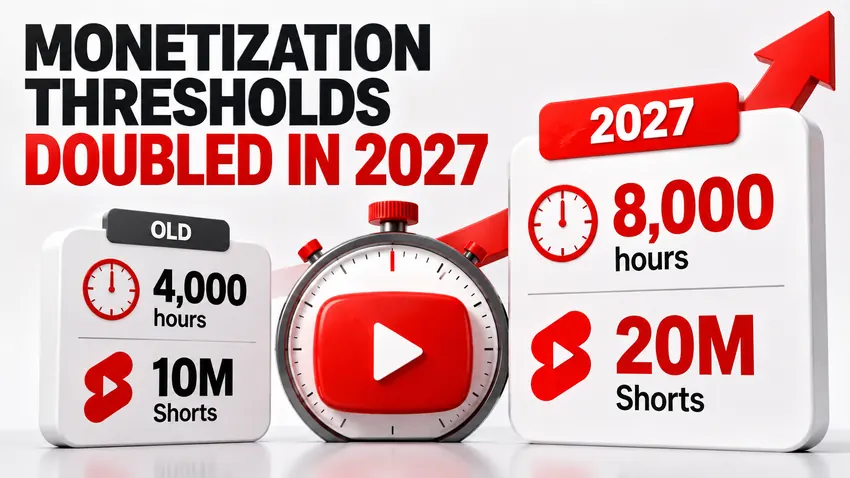
YouTube is making its biggest change to Partner Program entry requirements in years. Starting February 1, 2027, new creators seeking access to advertising and Premium revenue sharing will face much higher traffic thresholds: 8,000 qualified watch hours in the previous 365 days or 20 million qualified Shorts views in the previous 90 days.
The change effectively doubles the two traffic requirements that currently lead to full advertising-revenue eligibility. It matters especially for small and mid-sized channels, where reaching monetization has often been treated as the first major milestone in turning a YouTube project into a business.
Importantly, this is not just a rumor or an interpretation of a policy page. YouTube announced the change on its official blog on August 10, 2026.
YouTube monetization thresholds: current vs. 2027
| Route to ad revenue | Current threshold | From Feb. 1, 2027 for new applicants |
|---|---|---|
| Long-form videos | 4,000 valid public watch hours in 12 months | 8,000 qualified watch hours in 365 days |
| YouTube Shorts | 10 million valid public Shorts views in 90 days | 20 million qualified Shorts views in 90 days |
| Subscribers | 1,000 for full ad-revenue eligibility | YouTube has not announced a change to this threshold |
Until the new rules take effect, YouTube’s existing full-monetization requirements remain in place. You can review the current system in our guide to YouTube watch time requirements for monetization.
Who is affected by the new YPP rules?
The most important distinction is between new applicants and creators who are already members of the YouTube Partner Program.
- Creators already in YPP: YouTube says the new 8,000-hour / 20-million-Shorts entry thresholds will not remove them from the program.
- Creators applying from February 1, 2027: they will need to satisfy the new higher traffic requirement for ads and Premium revenue sharing.
- Creators using the earlier-access YPP tier: YouTube says entry thresholds for fan funding and Shopping products remain unchanged.
This means the change does not eliminate YouTube’s lower entry level for selected monetization features. In eligible countries, creators can currently obtain earlier access to features such as fan funding and Shopping with 500 subscribers, three valid public uploads in 90 days, and either 3,000 valid public watch hours in 12 months or 3 million valid public Shorts views in 90 days. What becomes substantially harder is reaching the level that unlocks revenue sharing from ads and Premium.
Shorts creators face a second major change
YouTube is also changing how Shorts revenue sharing works for creators who are already inside YPP. From February 1, 2027, a channel will need 10 million qualified Shorts views over the previous 90 days to receive ads and subscription revenue sharing from Shorts.
If a channel falls below that rolling threshold, YouTube says it will remain in YPP and can continue earning from eligible long-form content. Shorts revenue sharing resumes automatically once the channel moves back above 10 million qualified Shorts views in 90 days.
For Shorts-first creators, this makes sustained volume more important than a single viral spike. A creator who reaches 10 million views once but cannot maintain that level across a rolling 90-day window may see Shorts revenue turn on and off over time.
Why is YouTube raising the bar?
YouTube frames the decision as an adjustment to the enormous scale the platform has reached. The company says YouTube now generates more than 200 billion daily Shorts views and more than one billion hours of watch time on television screens every day. It also says more than 3 million creators are already in YPP.
From YouTube’s perspective, raising the entry threshold lets the platform concentrate traditional ad-revenue sharing on creators who already demonstrate a higher level of sustained audience activity, while experimenting with other incentives for smaller or growing channels.
For creators, however, the practical effect is clear: the distance between starting a channel and reaching full ad monetization becomes longer. Doubling the required watch hours is especially significant because watch time accumulates more slowly than raw views for many niches, while 20 million Shorts views in 90 days is a demanding target even for channels with consistent short-form output.
What the change means strategically for creators
1. Retention becomes even more valuable
If the long-form route requires 8,000 qualified hours, increasing average view duration becomes one of the most efficient ways to make each view contribute more. A channel with strong retention can reach the same watch-time total with far fewer views than a channel whose audience abandons videos quickly.
This makes fundamentals such as topic selection, opening hooks, pacing, structure and audience satisfaction even more important. Our article on the science of YouTube retention explains why retaining viewers is not merely an algorithmic advantage but increasingly a monetization advantage too.
2. Evergreen long-form libraries gain value
Channels that depend entirely on launch-week traffic may find the new threshold frustrating. By contrast, a library of searchable or evergreen videos can continue generating watch time month after month. Under a 365-day qualification window, dozens of moderately successful videos may be more useful than waiting for one breakout upload.
3. The Shorts route becomes a scale game
Twenty million qualified Shorts views in 90 days works out to an average of more than 222,000 views per day. That does not mean every day must hit the same number, but it illustrates the scale involved. For most emerging creators, Shorts can still be extremely useful for discovery and subscriber growth, but relying on Shorts alone as the fastest route to ad monetization becomes less predictable.
If short-form content is central to your strategy, our YouTube Shorts Ads Views page explains promotional options for increasing reach. As always, paid promotion should be evaluated as a visibility tool, not as a shortcut around YPP eligibility rules.
4. Do not confuse paid reach with qualifying watch time
This distinction becomes even more important under the new thresholds. Watch time generated through advertising campaigns has historically not counted toward the valid public watch-hours requirement for YPP. Buying legitimate promotion can help a video reach new viewers, build awareness and generate secondary organic activity, but creators should not assume that every paid view or every minute watched contributes directly to the monetization counter in YouTube Studio.
For creators who want to evaluate a video before investing in promotion, our Free YouTube Analyzer checks key video and channel signals and can help identify obvious weaknesses before more traffic is sent to the content.
YouTube is also expanding alternative revenue opportunities
The 2027 update is not entirely restrictive. YouTube also announced an expansion of Premium Lite to all countries where YouTube Premium is available. According to YouTube, 60% of net Premium Lite subscription revenue is allocated to a dedicated creator pool, compared with 30% for standard Premium, before revenue is distributed according to viewing activity and the applicable creator revenue share.
The company also says it plans new incentive programs tied to YouTube Shopping, brand partnerships, trend creation and channel growth. Details are still limited, so creators should treat these programs as potential additional income streams rather than guaranteed replacements for ad revenue.
What should creators do before February 2027?
- Check your current YPP progress in YouTube Studio. Know whether your bottleneck is subscribers, watch hours or Shorts views.
- Prioritize videos capable of accumulating watch time over months. Searchable tutorials, explainers, reviews and evergreen niche content can keep working after publication.
- Improve retention before chasing more traffic. More views do not solve a weak viewing experience efficiently.
- Diversify revenue early. Fan funding, Shopping, sponsorships, affiliate revenue, products and services can reduce dependence on YPP ads.
- Follow the official YPP documentation. YouTube may clarify definitions, transition details and eligibility mechanics before February 1, 2027.
Bottom line
The 2027 YouTube Partner Program update changes the economics of starting a monetized channel. For new applicants, the long-form threshold rises from 4,000 to 8,000 qualified watch hours, while the Shorts route rises from 10 million to 20 million qualified Shorts views in 90 days. Existing YPP members are protected from the new entry threshold, but Shorts revenue sharing will require continued scale.
The broader lesson is that YouTube is rewarding sustained audience activity more heavily. Channels that build durable libraries, stronger retention and multiple revenue sources will be better positioned than those designed around a single monetization milestone.
Preparing for YouTube monetization in 2027?
If you are not yet fully monetized, our focused channel audit can help you assess your current gap, watch-time efficiency, Shorts strategy and the priorities that matter before the new thresholds take effect.
Sources and further reading
- YouTube: New opportunities to earn and changes to the YouTube Partner Program (official announcement, August 10, 2026)
- YouTube Partner Program overview & eligibility
- Overview of the expanded YouTube Partner Program
- Punto Informatico: YouTube raddoppia le soglie per monetizzare

Consultant in communication and marketing, I support professionals and businesses in enhancing their online presence through tailored strategies.
With extensive experience in digital marketing, I focus on designing targeted social media campaigns and managing video promotion projects.
I conduct ongoing research on social networks, especially YouTube, analyzing its algorithms, user behavior, and content dynamics to inform effective practices.