Over the past several years, I have directly managed and observed YouTube advertising campaigns across multiple music releases, promotional cycles, and content environments, including videos subject to delivery restrictions.
One consistent observation has emerged from this work.
Campaign performance is not determined solely by initial configuration. Instead, it develops progressively through interaction between the advertising system and real viewer behavior.
Understanding this process is essential for achieving stable and efficient delivery.
YouTube Ads Operate as an Adaptive Distribution System
YouTube’s advertising infrastructure does not simply distribute ads mechanically based on static targeting parameters.
It operates as a continuously adapting system that evaluates how viewers respond to a video after exposure.
When a campaign begins, the system collects behavioral signals such as:
- whether viewers skip immediately
- whether they continue watching
- how long they remain engaged
- how their interaction compares to broader platform patterns
These signals influence how frequently and to whom the video is shown.
Google has publicly documented that its advertising systems use machine learning to continuously adjust delivery based on predicted viewer response and contextual relevance.
Source:
https://support.google.com/google-ads/answer/14753570
This means campaign efficiency is not fixed at launch. It evolves dynamically as behavioral data accumulates.
The Initial Calibration Phase
One of the most misunderstood phases of a YouTube ad campaign occurs during the first 24 to 72 hours.
During this period, delivery patterns may appear inconsistent. Cost per view, delivery speed, and reach may fluctuate.
This is not a malfunction.
It reflects the system testing different audience segments to determine where the video performs most efficiently.
As the system gathers sufficient data, delivery typically becomes more stable.
This aligns with Google’s documented learning phase, during which performance may vary while the system identifies optimal distribution patterns.
Source:
https://support.google.com/google-ads/answer/13020501
Premature intervention during this phase can interrupt the stabilization process.
Structural Stability Plays a Critical Role
One counterintuitive but consistently observable dynamic is that excessive manual adjustments can reduce campaign efficiency.
Frequent changes to targeting, structure, or delivery parameters force the system to restart portions of its calibration process.
This delays its ability to identify efficient distribution patterns.
In contrast, campaigns with stable structural configurations often improve over time as the system refines its delivery model.
Stability allows the system to complete its optimization cycle.
Budget Influences Scale, Not Efficiency
A common misconception is that increasing budget alone will improve campaign efficiency.
In practice, budget primarily affects scale.
Efficiency depends on how well the system can match the video with viewers likely to engage.
Two campaigns with identical budgets can produce dramatically different cost per view and delivery stability depending on behavioral alignment.
Budget amplifies efficiency when alignment exists. It does not create alignment by itself.
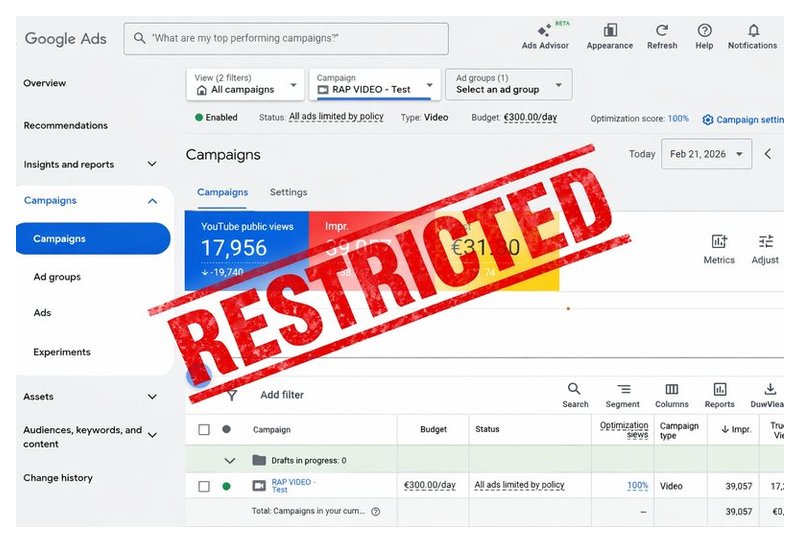
This is the actual campaign environment shown directly on YouTube:
Restricted Content Does Not Prevent Delivery
Another important observation is that delivery restrictions do not necessarily prevent campaigns from operating effectively.
Restrictions can alter distribution patterns, but stable delivery can still be achieved when campaigns are structured correctly and allowed to stabilize.
The system continues evaluating behavioral feedback and adjusting delivery accordingly.
Understanding this distinction is particularly important in music promotion environments where content restrictions are common.
Campaign efficiency emerges through interaction between multiple adaptive factors, including:
Performance Emerges Through System Alignment
- viewer behavioral response
- structural consistency
- accumulated data over time
- contextual alignment between content and audience
Performance is not purely mechanical. It is emergent.
The system continuously adapts based on observed behavioral patterns.
This explains why identical technical configurations can produce different results across different videos.
Practical Operational Implications
Several practical conclusions emerge from observing these dynamics:
- Structural integrity at launch is critical
- Stability often improves efficiency over time
- Early performance fluctuations are normal
- Budget affects scale, not inherent efficiency
- Excessive intervention can delay stabilization
Allowing the system to complete its calibration process is essential for achieving consistent delivery conditions.
Conclusion
YouTube advertising operates as an adaptive distribution environment driven by behavioral feedback.
Campaign efficiency develops progressively through alignment between content, viewer response, and system optimization processes.
Understanding this dynamic allows campaigns to reach stable and efficient delivery conditions, even in environments where delivery restrictions are present.
This distinction is essential for anyone working seriously with YouTube advertising infrastructure.
Related posts:
Your digital marketing strategy can’t be without YouTube
The Impact of Social Proof on YouTube: A Psychological Perspective
The Best YouTube Package to Buy: Enhancing Your Video Audience
Underperforming videos can hurt your Youtube channel?
Metaverse and Livestreaming Strategies for YouTube Channels in 2023

Consultant in communication and marketing, I support professionals and businesses in enhancing their online presence through tailored strategies.
With extensive experience in digital marketing, I focus on designing targeted social media campaigns and managing video promotion projects.
I conduct ongoing research on social networks, especially YouTube, analyzing its algorithms, user behavior, and content dynamics to inform effective practices.